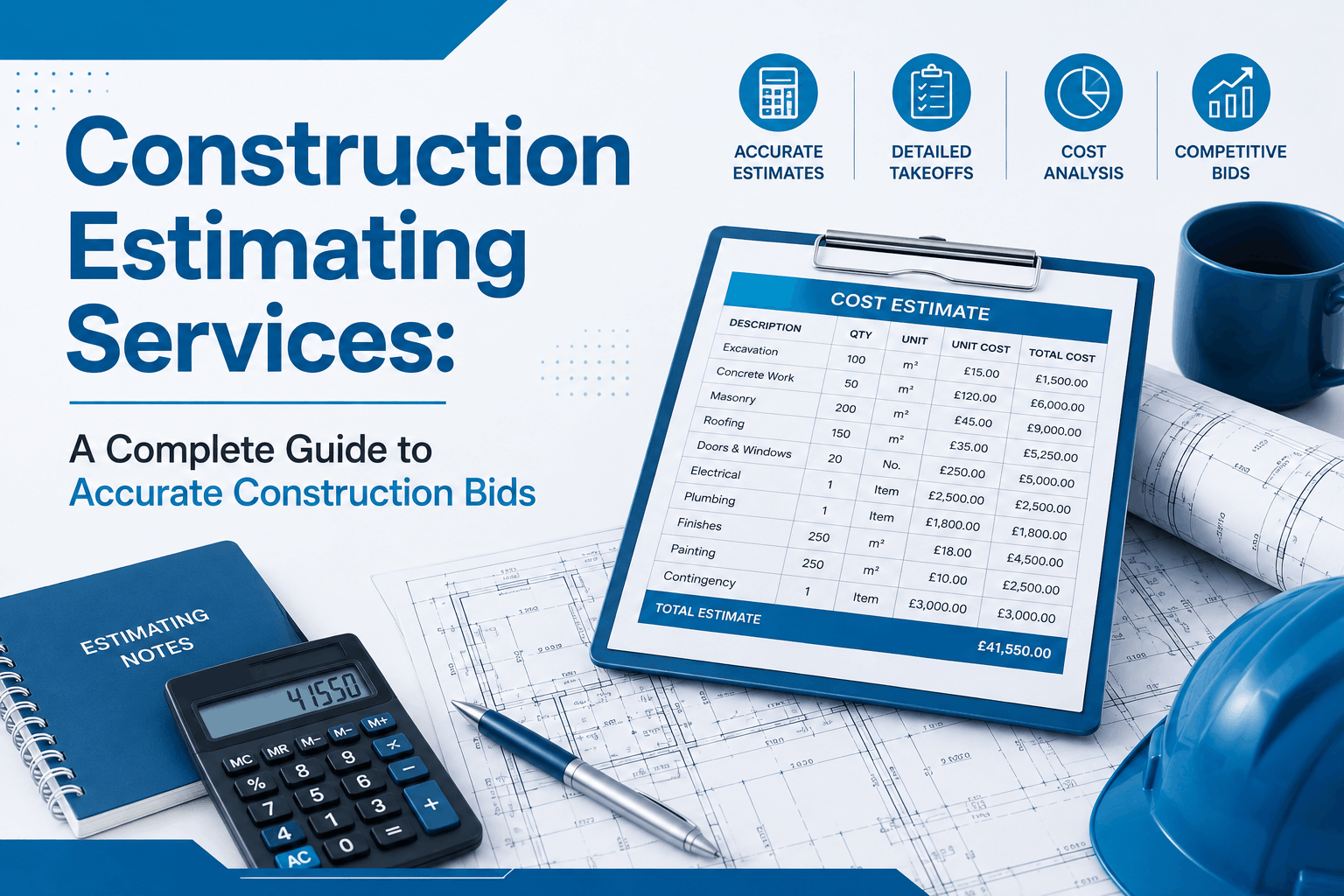
Construction Estimating Services: A Complete Guide to Accurate Construction Bids
Accurate pricing is one of the biggest factors behind a successful construction bid. Contractors need to understand the drawings, measure materials, calculate labor, account for equipment and subcontractor costs and build a realistic project budget before submitting a proposal. Professional construction estimating services bring these elements together into a structured estimate that contractors can use for bidding, procurement and project planning.
A construction estimate is more than a list of prices. It is a detailed representation of the project’s scope and expected cost. A reliable estimate should explain what is being built, how much material is required, how much labor is involved and what each part of the work is expected to cost.
True Bid Data provides professional quantity takeoffs and construction estimating support for contractors, subcontractors, developers, architects and consultants. Its services cover residential, commercial, institutional, civil, public and private projects, with estimates organized around CSI divisions and detailed material and labor pricing.
What Are Construction Estimating Services?
Construction estimating services involve analyzing construction documents and converting project information into measurable quantities and expected costs.
An estimator typically reviews:
- Architectural drawings
- Structural drawings
- MEP drawings
- Project specifications
- Scope of work
- Addenda and revisions
- Bid instructions
- Material requirements
- Labor requirements
The estimator then measures the required quantities and applies appropriate labor, material, equipment and other project costs.
For example, a concrete estimate may identify the quantity of concrete, reinforcing steel, formwork, excavation, finishing and related labor. An electrical estimate may quantify conduit, wire, panels, fixtures, devices and installation labor.
This makes estimating useful at several stages, including conceptual budgeting, preconstruction planning, competitive bidding, procurement and project cost control.
Construction Takeoff Services vs. Construction Estimating Services
The terms construction takeoff services and construction estimating services are closely related, but they are not exactly the same.
A construction takeoff primarily answers:
How much do we need?
A construction estimate goes further and answers:
How much will the project cost?
For example, a quantity takeoff might determine that a project requires a specific quantity of concrete, drywall, lumber, piping or electrical components. The estimator then uses those quantities with labor rates, material prices, equipment costs and other relevant pricing information to develop the overall estimate.
This is why quantity takeoff services are often considered the foundation of accurate estimating. True Bid Data describes its takeoffs as detailed labor and material quantity breakdowns that support accurate pricing and bidding.
The Difference Between Estimating and Takeoff in Construction
Understanding the difference between estimating and takeoff in construction helps contractors decide what type of support they need.
A takeoff focuses on measurement and quantity extraction. Estimating combines those quantities with pricing and other cost components.
Construction Takeoff
A takeoff may include:
- Square footage
- Linear footage
- Cubic quantities
- Item counts
- Material quantities
- Trade-specific quantities
- Drawing references
Construction Estimate
An estimate may include:
- Material costs
- Labor costs
- Equipment costs
- Subcontractor costs
- Overhead
- Markups
- Project-specific allowances
- Total bid price
Therefore, construction takeoff vs estimating should not be viewed as competing processes. They work together. A well-prepared takeoff gives the estimator reliable quantities, while the estimate converts those quantities into a financial picture of the project.
How to Do a Construction Cost Estimate Step by Step
If you are researching how to do a construction cost estimate step by step, the process begins well before entering numbers into estimating software.
Review the Complete Project Documents
Start with the drawings, specifications, scope, bid instructions and available addenda. The goal is to understand the complete project before measuring quantities.
Identify the Scope
Determine which trades and construction activities are included. This prevents important work from being accidentally excluded from the estimate.
Perform the Quantity Takeoff
Measure the materials and components shown in the drawings. Depending on the project, this may include concrete, masonry, framing, roofing, drywall, finishes, electrical systems, plumbing, HVAC, sitework and other trades.
Apply Material Pricing
Use appropriate material prices based on project location, specifications, supplier information and available cost data.
Calculate Labor Costs
Determine the labor hours and applicable labor rates required for each activity.
Add Equipment and Other Costs
Equipment, subcontractors, temporary work, permits, delivery, waste and other project-specific expenses may need to be included.
Review and Validate
Finally, review quantities, pricing, scope, exclusions and revisions before the bid is submitted.
True Bid Data describes a similar workflow of reviewing plans and specifications, performing quantity takeoffs, applying estimating data, quality-checking the work, and delivering organized bid documentation.
How to Read Blueprints for Material Takeoff
Learning how to read blueprints for material takeoff is one of the most important skills for a construction estimator.
A blueprint contains more than dimensions. Estimators must understand drawing scales, symbols, schedules, details, notes, elevations, sections and references between different drawing sheets.
A practical approach is to:
- Review the drawing index.
- Identify the relevant trade drawings.
- Check the drawing scale.
- Read general notes and specifications.
- Review plans, elevations, sections and details.
- Identify materials and assemblies.
- Measure quantities systematically.
- Cross-check the quantities against other drawings.
For complex projects, estimators should also review revisions and addenda so that outdated information does not make its way into the final estimate.
True Bid Data’s takeoff workflow includes reviewing project drawings and specifications and producing organized quantity reports, marked-up drawings and other bid-ready documentation.
How to Estimate Labor Cost in Construction
How to estimate labor cost in construction is another critical question because labor can represent a significant portion of the total project cost.
A basic labor calculation can be approached by determining:
Quantity × Labor Hours per Unit × Labor Rate = Labor Cost
For example, if an activity requires a certain number of labor hours per unit, the estimator multiplies the required quantity by the productivity rate and applicable labor cost.
However, real projects are more complicated. Labor productivity can be affected by project location, site conditions, crew composition, accessibility, construction methods, schedule requirements and project complexity.
True Bid Data states that it uses RSMeans data as part of its estimating approach, including labor, material and equipment cost information with location-adjusted data.
CSI Divisions Explained for Estimators
CSI divisions explained for estimators is an important topic because standardized organization makes estimates easier to review and compare.
The Construction Specifications Institute’s MasterFormat system organizes construction work into divisions. For example:
- Division 03: Concrete
- Division 04: Masonry
- Division 05: Metals
- Division 06: Wood, Plastics and Composites
- Division 07: Thermal and Moisture Protection
- Division 08: Openings
- Division 09: Finishes
- Division 22: Plumbing
- Division 23: HVAC
- Division 26: Electrical
Organizing takeoffs by CSI division helps contractors understand exactly where quantities and costs belong. True Bid Data specifically promotes CSI division-based takeoffs and estimating across its service offering.
Trade-Specific Construction Estimating Services
Not every construction estimate can be prepared using the same measurement approach. Each trade has different materials, units, installation methods, and cost considerations.
Electrical Takeoff Services
Electrical takeoff services quantify electrical components such as wiring, conduit, panels, fixtures, devices and related materials. Accurate electrical quantities help electrical contractors prepare competitive bids without overlooking required components.
Plumbing Quantity Takeoff
Plumbing quantity takeoff services measure piping, fittings, fixtures, valves, equipment and other plumbing components shown in the project documents.
HVAC Estimating Services
HVAC estimating services cover equipment, ductwork, piping, insulation, controls, accessories and associated installation requirements.
Concrete Takeoff Estimating
Concrete takeoff estimating can include foundations, footings, slabs, walls, columns, beams, reinforcing steel, formwork and related concrete work.
Drywall Takeoff Calculator Guide
A drywall takeoff calculator guide can help with preliminary measurements, but detailed projects require drawing-based quantity calculations that account for wall types, ceiling systems, openings, thicknesses and specifications.
Lumber and Framing Takeoff Estimate
A lumber/framing takeoff estimate can include studs, plates, joists, rafters, sheathing, trusses, blocking, engineered wood and other framing components.
These trade-specific estimates can then be incorporated into a comprehensive project estimate.
Construction Takeoff Software: Choosing the Right Digital Tools
Modern estimating teams increasingly use digital software to improve the speed and accuracy of quantity measurements. The right construction takeoff software can help estimators measure directly from digital drawings, organize quantities, identify revisions and prepare reports more efficiently.
However, software should support an estimator’s judgment rather than replace it. Drawings can contain incomplete information, conflicting details, revisions and project-specific requirements that still require professional review.
PlanSwift vs. Bluebeam vs. On-Screen Takeoff
When researching the best software for construction takeoff, contractors commonly compare platforms such as PlanSwift, Bluebeam and On-Screen Takeoff.
PlanSwift is widely used for detailed digital takeoffs and estimating workflows. It can be particularly useful when estimators need measurement tools combined with estimating capabilities.
Bluebeam Revu is strongly focused on PDF drawing review, measurement, markup, collaboration and document management. It can be useful when teams need to review and annotate construction documents alongside their measurements.
On-Screen Takeoff is designed specifically around digital construction takeoff workflows and can help estimators measure quantities from electronic plans.
The right choice depends on the estimator’s workflow, project type, drawing format, reporting requirements and integration needs. There is no single software platform that is automatically the best option for every contractor.
At True Bid Data, digital estimating technology is combined with professional estimating experience to create organized quantity takeoffs and construction estimates. The company describes its workflow as using digital tools alongside experienced estimators rather than relying solely on automated measurements.
Can AI Perform Construction Takeoffs?
AI is becoming increasingly relevant to the construction estimating industry. AI for construction takeoff can assist with recognizing drawing elements, measuring quantities, identifying objects and automating repetitive estimating tasks.
However, the question “Can AI do construction takeoffs?” requires a more careful answer.
AI can potentially automate portions of a takeoff, but a professional estimator is still important for validating the results. Construction drawings often contain exceptions, ambiguous details, specifications, revisions and scope requirements that automated systems may not interpret correctly.
A practical AI-assisted workflow can look like this:
- Upload or process digital drawings.
- Allow software to identify measurable construction elements.
- Generate preliminary quantities.
- Review measurements against drawings and specifications.
- Correct missing or incorrect quantities.
- Apply pricing and labor information.
- Complete a professional quality-control review.
Therefore, AI takeoff construction technology should be viewed as an efficiency tool rather than a complete replacement for estimating expertise.
How Much Does Construction Estimating Cost?
The question “how much does construction estimating cost?” does not have one universal answer. Pricing depends on the size, complexity, location, trade coverage, number of drawing sheets, project type and turnaround requirements.
A small residential project may require considerably less estimating work than a large commercial or industrial development.
Factors that commonly affect estimating costs include:
- Project size
- Number of drawing sheets
- Number of trades
- Drawing complexity
- Level of detail required
- Project location
- Bid deadline
- Quantity of revisions
- Material and labor pricing requirements
Contractors should compare estimating providers based on accuracy, scope, turnaround, experience and reporting quality rather than selecting a service solely because it has the lowest price.
How to Win More Construction Bids
Accurate estimating is only one part of successful bidding. Contractors also need a consistent process for evaluating opportunities and preparing proposals.
If you want to know how to win more construction bids, focus on the following:
Bid Selectively
Not every project is worth bidding. Evaluate the project’s scope, client, competition, schedule, location and expected profitability before investing estimating resources.
Understand the Plans
Read the drawings and specifications carefully. Missing a scope item can turn an apparently profitable project into a loss.
Build Accurate Quantities
A reliable quantity takeoff creates a stronger foundation for the estimate. Review quantities by trade and cross-check important measurements.
Calculate Labor Carefully
Labor productivity, crew composition, site conditions, project schedule and installation methods can all influence labor costs.
Review Subcontractor and Supplier Pricing
Where subcontractors or supplier quotations are required, compare quotations carefully and make sure they cover the complete scope.
Check Exclusions and Addenda
Before submitting the bid, confirm that all addenda and revisions have been incorporated and that exclusions are clearly identified.
Protect Your Margin
A competitive bid does not necessarily mean the lowest bid. The goal is to submit a price that is competitive while still allowing the contractor to cover costs and achieve a reasonable profit.
Public vs. Private Construction Bidding Process
The public vs. private construction bidding process can differ considerably.
Public projects often follow formal procurement procedures, defined bid requirements, deadlines, specifications and documentation requirements. Contractors may need to follow specific submission instructions and comply with applicable procurement rules.
Private construction bidding can be more flexible. Owners, developers, general contractors or construction managers may request proposals from selected contractors and evaluate pricing alongside experience, schedule, qualifications and scope.
Regardless of project type, a detailed estimate helps contractors understand their expected costs before submitting a proposal.
When Should You Outsource Construction Estimating?
Many contractors eventually reach a point where their internal team cannot keep up with every bid opportunity. This is where outsource construction estimating services can provide additional capacity.
Outsourcing can be particularly useful when:
- Your team has multiple bids due at once.
- You need specialized trade estimating.
- You do not have a full-time estimator.
- Your estimator is overloaded.
- You need additional estimating capacity.
- You are entering a new construction market.
- You want to reduce estimating overhead.
Instead of turning away potential projects because your team lacks the time to prepare estimates, outsourcing gives contractors access to additional estimating resources.
How to Hire a Construction Estimator
If you are planning to hire a construction estimator, evaluate more than technical software skills.
Look for experience with:
- Construction drawings
- Specifications
- Quantity takeoffs
- Material pricing
- Labor calculations
- CSI divisions
- Digital estimating software
- Bid preparation
- Quality control
- Your specific construction trade
Ask potential estimating providers how they handle drawing revisions, missing information, addenda, quality checks and project deadlines.
For contractors who do not want to build a large internal estimating department, a professional construction cost estimating company can provide flexible estimating capacity.
Construction Estimating Services in New York
New York contractors operate in a competitive construction market where accurate pricing and efficient bid preparation can make a significant difference.
Construction estimating services New York can support contractors working on:
- Single-family homes
- Multi-family buildings
- Commercial properties
- Renovations
- Institutional facilities
- Public projects
- Industrial developments
For contractors specifically searching for construction takeoff services NYC, detailed digital quantity takeoffs can help simplify complex drawings and provide organized quantities for bidding.
True Bid Data offers estimating and takeoff support for contractors working across different project categories and locations. Its service model is designed around detailed quantity reporting and construction estimating rather than simple automated measurements.
Residential Construction Estimator Near Me
Contractors searching for a residential construction estimator near me are usually looking for someone who understands local construction requirements, material pricing, labor conditions and residential project types.
A local estimator can be valuable when the project requires location-specific knowledge. However, remote estimating services can also support residential contractors when the estimating provider has access to appropriate regional pricing data and understands the project’s location.
The most important consideration is not simply physical proximity. Contractors should evaluate the estimator’s construction knowledge, accuracy, turnaround, technology and ability to understand the project’s scope.
Accurate Quantity Takeoff for Contractors
An accurate quantity takeoff for contractors should be detailed enough to support both estimating and purchasing decisions.
A professional takeoff should clearly identify:
- Item descriptions
- Quantities
- Units of measurement
- Trade or CSI division
- Drawing references
- Relevant assumptions
- Scope inclusions
- Important exclusions
This organization makes it easier for contractors to review the estimate, request supplier quotations, compare pricing and identify potential scope gaps.
Why Contractors Choose Professional Construction Estimating Experts
Contractors often need more than software. They need people who understand how construction documents translate into real-world costs.
Professional construction bid estimating experts can help contractors:
- Interpret complicated drawings
- Identify missing scope
- Perform detailed quantity takeoffs
- Calculate labor requirements
- Apply material pricing
- Review revisions
- Organize bid documentation
- Meet demanding bid deadlines
True Bid Data positions its estimating services around professional quantity takeoffs and construction estimates for contractors and other construction professionals.
Conclusion
Professional construction estimating services provide contractors with a structured way to understand project quantities, labor requirements, material costs and overall construction expenses before submitting a bid.
A strong estimating process begins with accurate construction takeoff services and quantity takeoff services, then combines those quantities with reliable labor, material, equipment and project cost information. Digital takeoff software and AI can make the process faster, but experienced estimating professionals remain important for interpreting drawings, specifications, revisions and project scope.
For contractors looking to hire a construction estimator, outsource construction estimating, improve bid preparation or obtain an accurate quantity takeoff for contractors, the right estimating partner can provide valuable additional capacity.
True Bid Data supports contractors with professional estimating and takeoff services designed to turn complex construction documents into organized, usable estimating information. Whether the project is residential, commercial, institutional, civil, public or private, accurate estimating gives contractors a stronger foundation for making informed bidding decisions.